


Table of Contents
When procuring iron pyrite (FeS2) for industrial applications, the chemical purity—specifically a high sulfur content of 45% to 50%—is often the first metric evaluated. However, experienced procurement managers and facility engineers know that physical specifications are just as critical as chemical composition. The particle size of iron pyrite fundamentally dictates its reaction rate, melting efficiency, oxidation behavior, and handling requirements.
For business buyers in sectors ranging from heavy steel smelting to new energy battery manufacturing, choosing between fine grades (3-15mm) and lumpy grades (10-50mm) can significantly impact production efficiency and overall costs. This comprehensive guide breaks down the technical differences, ideal use cases, and procurement considerations for 3-15mm and 10-50mm iron pyrite.
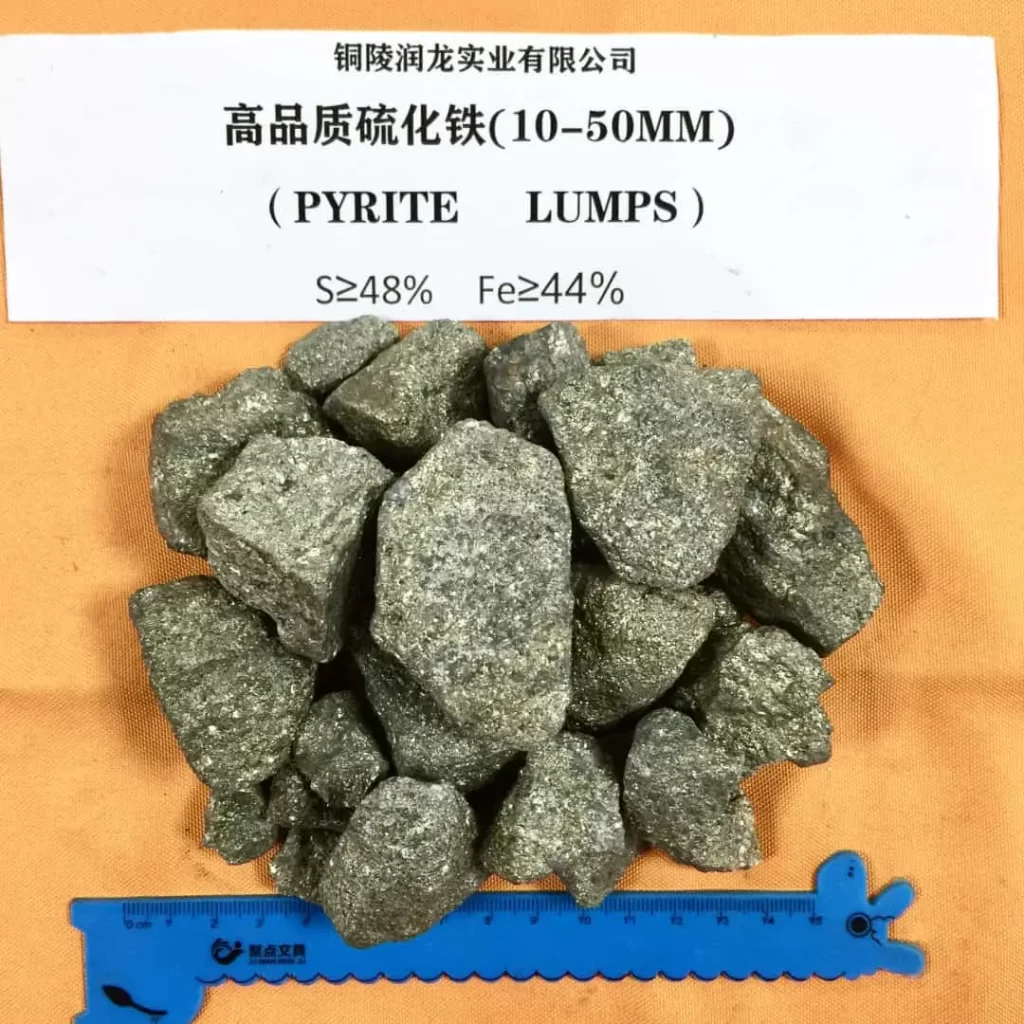
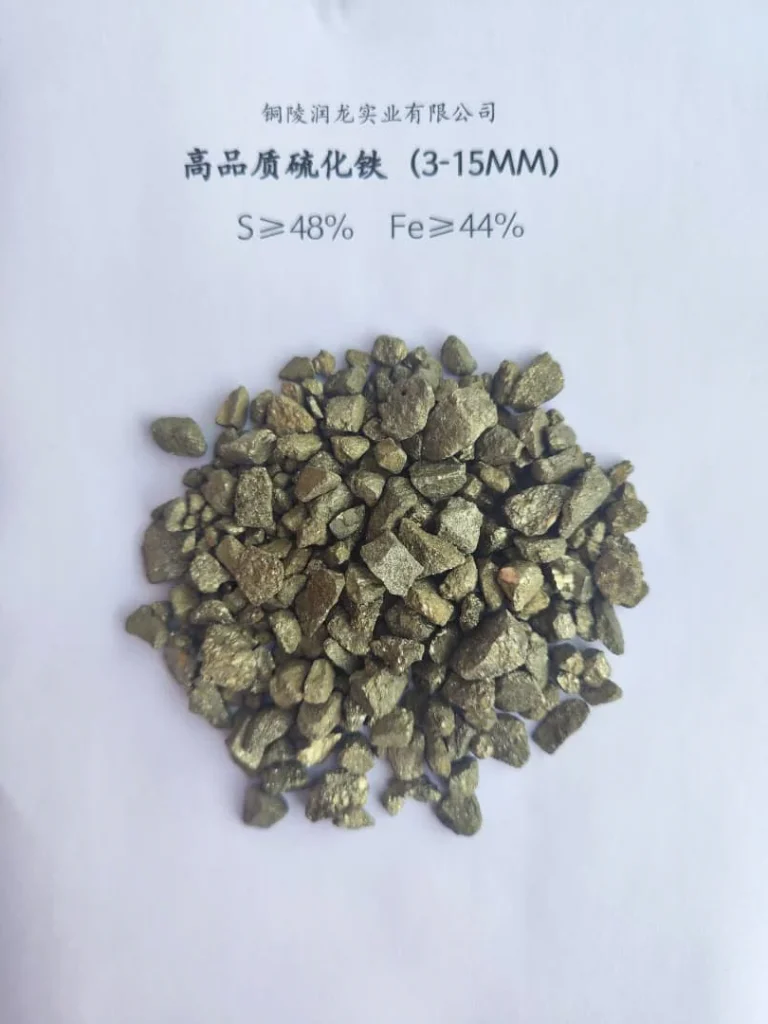
The Strategic Importance of Particle Size in Ferrous Sulfide
Iron pyrite, commonly known as fool’s gold, is primarily utilized as a resulfurizing agent in the metallurgical industry, a filler in abrasives, and a crucial raw material in chemical engineering.
Particle size affects the total surface area exposed during chemical reactions and smelting processes. A smaller particle size offers a vastly increased surface area, leading to rapid ignition, faster melting, and quicker integration into molten states. Conversely, a larger particle size provides a slower, more controlled release, reduces dust loss in high-draft furnaces, and minimizes premature oxidation during transit and storage.
Understanding these physical dynamics is essential for optimizing your specific manufacturing process.
Deep Dive: 3-15mm Iron Pyrite (Fine Grade)
The 3-15mm specification is a highly versatile, finely crushed grade of iron pyrite. Its primary advantage is rapid reaction kinetics due to its high surface-area-to-volume ratio.
Key Industrial Applications
1. Abrasives Manufacturing (Grinding Wheels)
In the production of resin-bonded grinding wheels and brake pads, 3-15mm iron pyrite is often milled further or used directly as an active filler. Its finer size ensures an even distribution within the resin matrix. Pyrite acts as a coolant and an anti-glazing agent during high-friction grinding, significantly extending the abrasive tool's lifespan and preventing workpiece burning.
2. Glass Manufacturing
The glass industry utilizes fine iron pyrite to produce amber-colored glass. The 3-15mm size melts rapidly and uniformly within the glass furnace, allowing the iron and sulfur compounds to disperse evenly. This ensures consistent coloration and prevents structural weaknesses caused by unmelted inclusions.
3. Emerging New Energy Sectors
With the rapid expansion of the new energy vehicle (NEV) market, iron pyrite is seeing increased demand in the manufacturing of lithium-ion battery cathode materials (specifically Lithium Iron Phosphate - LiFePO4). The 3-15mm grade serves as a highly reactive, pure precursor material, where rapid chemical integration is required for efficient mass production.
Operational Advantages and Challenges
- Advantage: Rapid melting and high dissolution rate, reducing furnace time and saving energy.
- Challenge: Higher susceptibility to oxidation and moisture absorption during storage. Requires strict inventory management to prevent degradation and the risk of spontaneous combustion in large stockpiles.
Deep Dive: 10-50mm Iron Pyrite (Lumpy Grade)
The 10-50mm specification is considered a lumpy or coarse grade. This size is purpose-built for heavy industrial environments where high temperatures, strong furnace drafts, and the need for prolonged chemical release are the norm.
Key Industrial Applications
1. Free-Cutting Steel and Heavy Metallurgy
In the production of free-cutting steel, sulfur must be added to the molten iron to improve the steel's machinability. The 10-50mm lumpy iron pyrite is the industry standard for this process. Its larger mass allows it to penetrate the slag layer and reach the molten metal before burning off. A finer grade would simply be swept away by the furnace exhaust or oxidize prematurely on the surface.
2. Large-Scale Foundry Operations
Foundries producing heavy machinery components, automotive engine blocks, and industrial cast iron rely on 10-50mm pyrite for carbon and sulfur adjustments. The lumpy size ensures a steady, controlled absorption rate into the melt, providing metallurgists with precise control over the final alloy composition.
3. Soil Remediation and Agricultural Conditioning
In large-scale agricultural projects aimed at correcting highly alkaline soils, lumpy iron pyrite is sometimes utilized. The 10-50mm chunks break down slowly over several seasons, providing a long-term, sustained release of sulfur to maintain optimal soil pH levels without the need for constant reapplication.
Operational Advantages and Challenges
- Advantage: Minimal dust loss in blast furnaces, high penetration through slag layers, and excellent stability during long-haul bulk shipping.
- Challenge: Slower dissolution rate compared to finer grades; requires adequate furnace time to fully melt and integrate.
Technical Comparison Matrix
To streamline your procurement decision, reference the comparative data below:
| Specification Metric | 3-15mm Iron Pyrite (Fine) | 10-50mm Iron Pyrite (Lumpy) |
| Surface Area | High | Low |
| Reaction/Melting Rate | Rapid | Slow / Controlled |
| Furnace Draft Loss | High (Prone to exhaust loss) | Low (Retains mass) |
| Slag Penetration | Poor | Excellent |
| Storage Stability | Moderate (Prone to moisture) | High (Resists oxidation) |
| Primary End-Use | Abrasives, Glass, Batteries | Steel Smelting, Heavy Castings |
How to Choose the Right Specification for Your Supply Chain
Selecting the optimal iron pyrite size is a balance between process efficiency and material handling capabilities.
- Analyze Your Equipment: If you utilize electric arc furnaces (EAF) with powerful extraction systems, 10-50mm is necessary to prevent expensive raw materials from being pulled into the dust collection system. If you operate controlled, enclosed chemical reactors, 3-15mm will yield faster throughput.
- Evaluate Transportation and Storage: Bulk maritime shipping of 3-15mm pyrite requires stricter moisture controls to prevent caking and oxidation. 10-50mm lumpy pyrite is generally more robust for open-bulk transport and extended yard storage.
- Calculate the Total Cost of Ownership (TCO): While finer grades might occasionally command a slight premium due to the extra crushing required at the mine, the energy saved through faster melting times often offsets the initial procurement cost.
Frequently Asked Questions (FAQ)
Can I mix 3-15mm and 10-50mm iron pyrite in the same furnace?
While possible, it is rarely recommended. Mixing sizes leads to unpredictable melting rates, where the fines may oxidize and burn off before the lumps have fully integrated, complicating metallurgical calculations.
Does the particle size affect the sulfur content?
No. Assuming the pyrite is sourced from the same high-quality vein, a 3-15mm batch and a 10-50mm batch will possess the identical chemical purity (typically >45% Sulfur). The difference is purely physical.
How should iron pyrite be stored to maintain its quality?
Regardless of size, iron pyrite should be stored in a dry, well-ventilated area, ideally under cover. Finer grades (3-15mm) require particular attention to prevent moisture absorption, which can lead to the formation of sulfuric acid and degrade the material.